Monday, March 11, 2024

Relationship with technology

 Technology: The Good, The Bad, The Ugly



I have been exposed to technology since the day I gained consciousness, and in turn I feel I have had a grasp on it for as long as I can remember. Technology has continually evolved society, in fact it has advanced more in the past 100 years than it has in the last million. It has improved science and medicine drastically, furthering our understandings and increasing life expectancy, I'm sure soon it will jump another 50 years (I'm good at 80). 
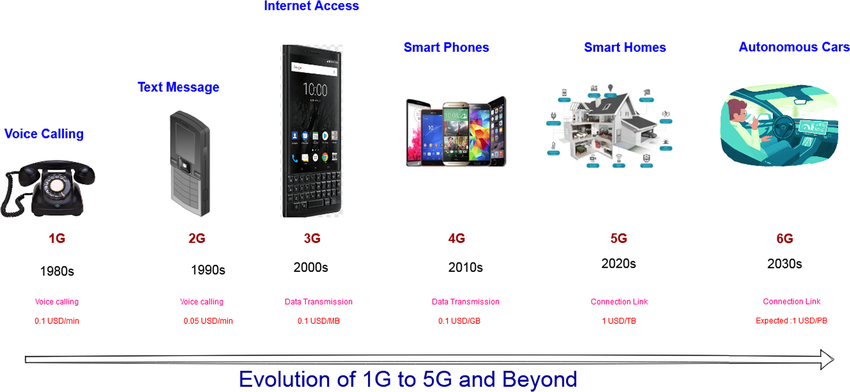

My relationship with technology has definitely had its ups and downs, as with technology there is always good and bad. Currently, absolutely. My relationship with technology is stellar, my phone screen time is roughly three and a half hours a day, and I use it to help my studies and own personal endeavors. I honestly find myself sometimes wishing smart phones did not exist, so people would communicate more and be with each other more. For example, I was watching "Stand By Me" the other day, and a lot of the movie I felt myself jealous of the boys just outside exploring and adventuring, their parents having no clue where they truly are, they were utterly free.

However, back in the day, absolutely not. I spent hours and hours and hours playing video games, and/or sitting at a desk on a computer and it had some effects on my body, such as eye strain and overall poor posture. I spent more time mindlessly scrolling and thrashing my attention span then I did putting my time towards something that could better me or that I actually care about. Sometimes today, when I'm reading on my phone, my head is down and my phone is by my lap, further worsening my posture, something I am currently working on, but overall my habits are much better. 


Technology is very powerful and allows us instant access to information, resources, and expertise. However, being able to access that information at any time does not mean that we understand the information. We are not really learning it, we are just seeing it and potentially reciprocating it. A huge drawback with this is misinformation, whether it be intentional or not. The beauty, and downside, of the internet is that anyone can upload their opinion or information about a topic. This can lead to people making stuff up, fake news, or slander against a person or topic. Which leads to a misinformed public and the spread of that false information to the masses. Honestly, when I perceive information, and this is something I have been trying to work on, I tend to immediately believe what is said without considering the idea that it could be false or spun.  I feel that a lot of people consume information today, and especially at such a fast rate, that people do not tend to stop and take the time to analyze what they are consuming. Creating a nation of false information spread that people will believe in no questions asked and cause the masses to potentially panic.


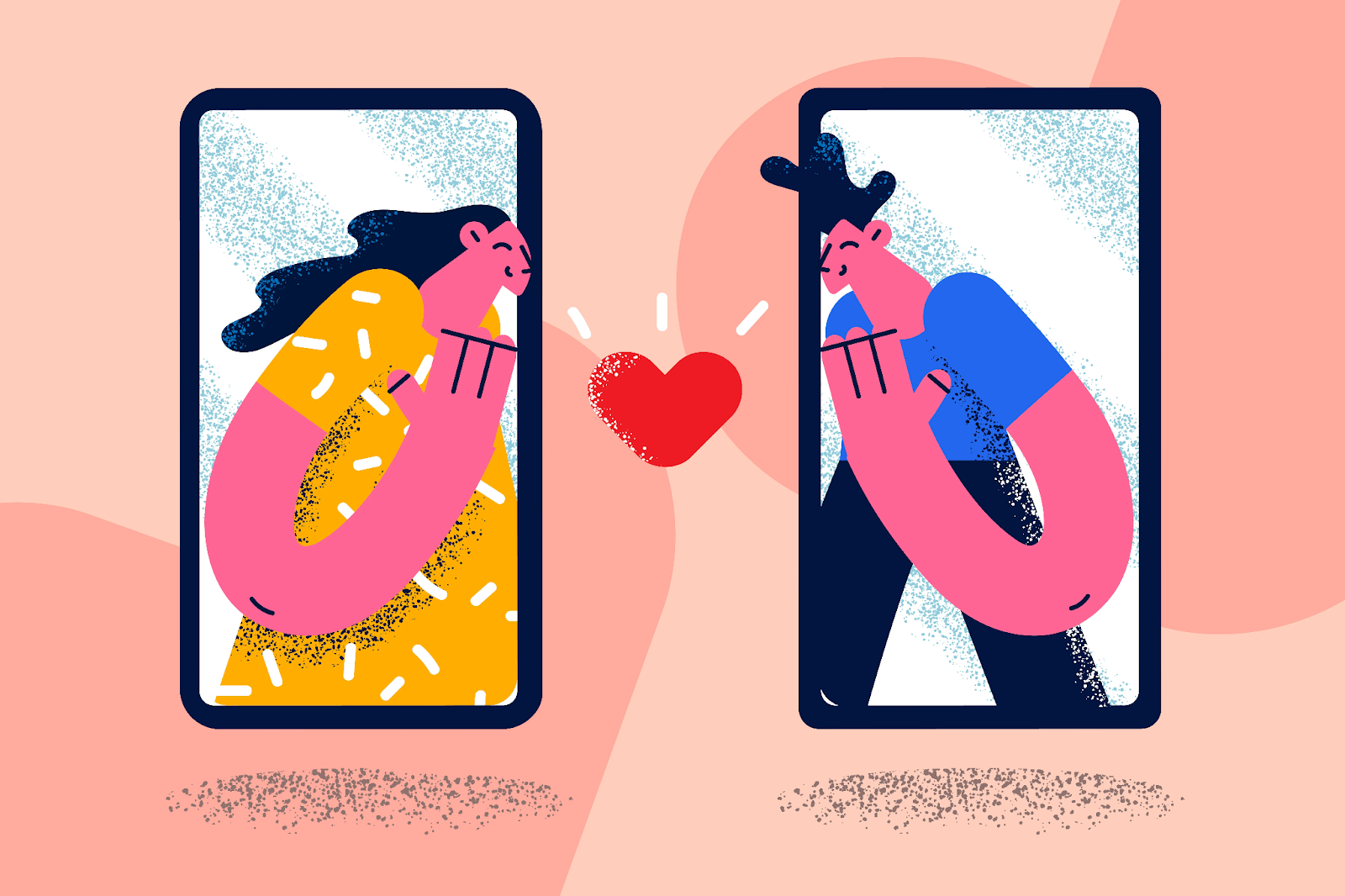
I think for most people, technology has improved their lives in the aspect of saving time and information access. It has also exponentially imrpoved things such as science and medicine. There is also the dark side to technology such as cyberbullying which has increased the suicide rates, especially in the youth. It allows anyone to see your posts (if you let them) and comment whatever they want to or about you. Technology also connects people in ways that weren't so easily accessible back then, for example: instant messaging, social media, etc. These allow friends and families to stay connected even if they are thousands of miles apart. It allows you to keep up with what they are doing and could even allow you to become friends with total strangers. However, with every good there is bad, like the ability to prey on children through social medias or traffic people for example. 


The online footprint is something that stays with everyone, and I could not even fully tell you what would be on mine. There would be both good and bad things, with the bad things being something I definitely do not want a potential employer to see. The posts I interact with are both good and somewhat bad, but anyone could take anything the wrong way, especially today, and blow you out of the water. Luckily, and maybe also not, my online presence is very little, with only my linked in being available when you google me. However, there is also nothing that stands out about me, something employers may also look at with displeasure.

All in all, I think the good that technology brought the world far outweighs the bad. However, as humans do, people tend to forget about the good and solely focus on the bad. While the bad can be very bad, I still believe the good is greater. Technology will only continue to evolve, soon we may even enter a trans-humanism era in which part of us is machine. Something that I think could either utterly profit the human race or plummet it into darkness and control.

Monday, February 26, 2024

Privacy in the Digital Age

Privacy: How Private Are You Really?


There were a lot of issues raised in the ted talks delving into our privacy and how private we really are. The first ted talker discussed the ideas that companies such as Facebook, Google, Amazon, etc. are just electronic tattoos that keep information on you, that they can say a lot of things without words. The idea that electronic tattoos can also be a shadow of immortality, as the data it collects will far outlast our physical bodies in this digital world. He also discussed facial recognition being able to identify people in a photo simply based off their face. 


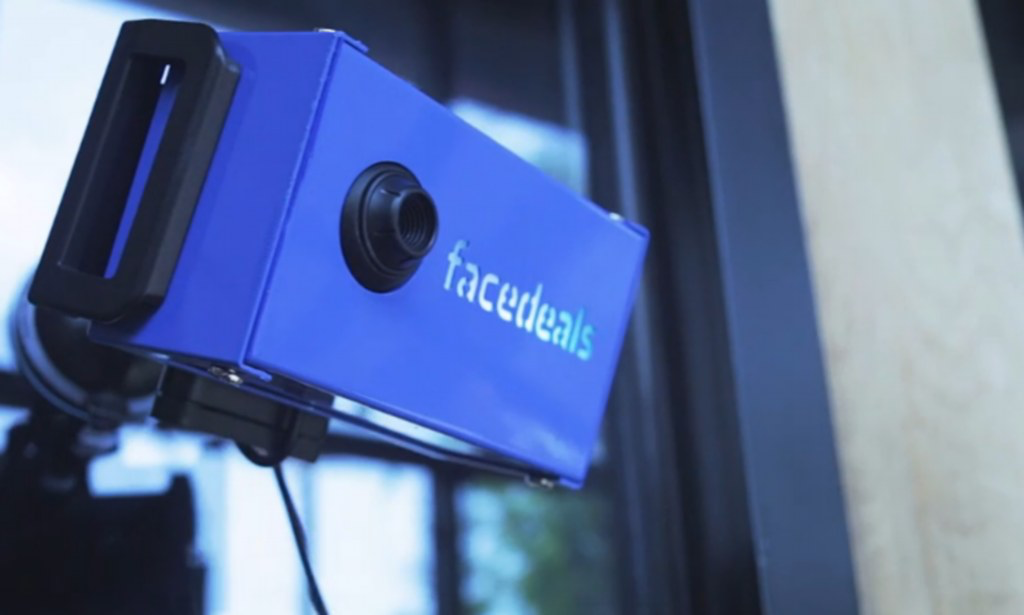
It has become so advanced that people are able to take a picture, get a name, and download all information available on that person without speaking a single word. Companies like face.com, which I never heard of, is a company that does exactly that. In 2012 they sold to Facebook, allowing them to have all that data. Companies also used face.com tech to find out someones shopping preferences, like if the camera in the store tells the sales associates that their customer likes black dresses, they can go out and say we have x amount of black dresses we think would look great on you.


The government uses the police to track what is called location information, which means they can see things such as where you travel, if you go to a therapist, AA meetings, or if you do or do not go church, etc. The Police use this information to make decisions about who you are and essentially how they will treat you. They have automatic license plate readers, mounted on roads, police cars, everywhere and the police keep records of every plate that passes them by. 


Our phones are wired for surveillance first and foremost, and essentially anyone could be listening to us, not just our government, it could be a third party person stealing your info or hackers attempting to hack you, anyone. This can lead to things such as revenge porn, or as the ted talker called it, "digital domestic violence." Where the offender uses cell phones and laptops, armed with photos and videos instead of physical harm. 


These are all things that have the ability to affect both myself and my family in today's digital world. These things are very prominent in my life, as I use Face ID every day to login to my iPhone and I use google everyday to look things up or access the sites that I want to. The government should respect the privacy of the people and put in safeguards to protect people from their privacy. However, there is always the chance of hackers and those who just want to hurt, but they should be able to regulate themselves and corporations to respect the privacy of its people. For now however, our best strategy is to be aware of what we are talking about around our tech and be aware that things such as targeted marketing exist. 


Thursday, February 22, 2024

Learning from the class 2

Cutting the Cord


Cutting the cord, a term some have heard others probably not, and when I first heard this term for some reason I envisioned the umbilical one. When you understand what this is referring to however, it makes much more sense.

 Cutting the cord refers to the canceling of cable television by families in favor of wireless methods of receiving programs. These programs include internet protocol television, digital terrestrial television and satellite television. Internet protocol refers to TV programming available over an internet stream. Digital terrestrial refers to TV transmitted from radio frequencies. Satellite refers to TV received through a satellite, typically through a paid subscription. 

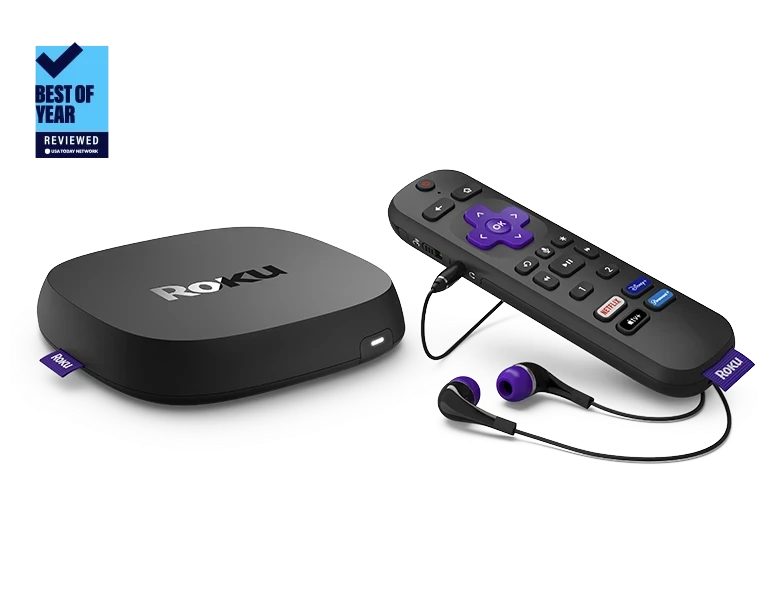
Usually, however, cutting the cord refers to free to air satellite televisions. This is due to the expense of cable compared to other more affordable, better mediums. This is very common in the majority of American homes, as most people use things like Roku, to give them access to the streaming sites such as Netflix and HBO. For news, the satellite is your friend, however in our current society a lot of people use the internet or apps for their news.


What has this done for us as a society and how has it impacted our daily way of viewing entertainment, news, etc. It allowed entertainment to transition to different kind of commercial content, that of shorter ads with less ad time. It created a new form of news, as I stated earlier, it say television news get less popular. As seen throughout history it affects the old and the young quite differently. While the young seem to be born with a grasp of technology, it seems to slip the grasp of the old. Meaning, the old will probably stick to what they are used to as if it ain't broke, don't fix it. There is also the rich vs. the poor, as the rich are able to pay for the better subscriptions, having them view less ads, while the poor can only get the basic, if any, subscriptions. This has lead to an increase in piracy, which is the downloading of paid content illegally for free, to which I am a modern day Blackbeard. It has effected me, and I'm sure all reading this, as we use streaming sites and satellite to view our entertainment or information, and there is not shot in hell I'm going back.

Monday, February 19, 2024

Net Neutrality

Net Neutrality


    Net neutrality. A term I'm sure everyone has at least heard of before. If you are around my age, you remember being in high school or middle school, terrified at the idea that the freedom of the internet could be taken away from you, and even worse you could be charged to access it at high speeds. The idea of this was expressed to you before the you arrived at the realization the internet could even be marketable. You also remember the former chairman of the FCC Ajit Pai, or as I liked to call him, stupid idiot. 


So what is net neutrality? Net neutrality is essentially a principle, it holds that an entrepreneur's novice company should be given the same opportunity to succeed as established corporations, and the ability to access a blog from a high school student should not be infringed upon by making way for advertisers who are more affluent. Like former President Barack Obama said, this allows for the opportunity for the next Google or Amazon and essentially the betterment of society and innovation. 


It is important. Net neutrality is important not only on an economic level, it is also important on an educational level. Defined as by Loyola U., digital equity is "the concept that all students should have access to technology, such as devices, software, and the internet, and trained educators to help them navigate these tools." This principle is immensely important in this age of technology as the internet has profited teachers and students by allowing first-rate information, resources, and expertise to be instantly accessible. Something our country has a history of not having available for its citizens.

TIMELINE 

OCT. 29 2007 - Then senator Obama pledges support for net neutrality if elected president. His position being "I am a strong supporter of net neutrality... [there has been] lobbying that says the [internet] servers through which you're getting information should be able to [gate keep] and charge different rates to different websites... I think it destroys one of the best things about the internet--which is that there is incredible equality there." 

MAY 2010 - Strong net neutrality safeguards are introduced by the FCC, stating internet service providers have no right to put restrictions on users or block websites. Later, the FCC would approve a final version in December, enacting the first internet access regulations in history.

JAN. 2011 - Very shortly after the adoption of these rules by the FCC, a lawsuit filed by Verizon Communications would eventually nullify the order.

JAN. 14 2014 - A federal appeals court negates the 2010 rule issued by the FCC.

JAN. 15 2014 - Signed by 105,572, a user created petition on the White House's We The People platform is born asking the Obama administration to "Restore Net Neutrality By Directing The FCC to Classify Internet Providers as 'Common Carriers'."

FEB. 18 2014 - In response to the petition, the White House reiterates its support for an open and unrestricted internet, but clearly maintains that it is unable to control the rule-making process for an independent organization.

MAY 16 2014 - For a period of time, the public is invited to comment on the rule after the FCC issues a notice of proposed rule-making on internet regulatory structure. 

AUG. 5 2014 - President Obama on net neutrality: "I personally, the position of my administration, as well as a lot of the companies here, is that you don't want to start getting a differentiation in how accessible the Internet is to different users. You want to leave it open so the next Goole and the next Facebook can succeed."

SEP. 15 2014 - The comment session with the FCC comes to an end, seeing nearly four million public comments by the people about net neutrality, more than the FCC has received on any other issue. 

NOV. 10 2014 - In order to preserve net neutrality, President Obama calls on the FCC to adopt the strictest regulations available. 

FEB. 26 2015 - To maintain an open and free internet, the FCC votes in favor of strict net neutrality regulations.

JUNE 14 2016 - A federal court of appeals recognizes that economic growth and innovation depends on an open internet, fully supporting the FCC's strict net neutrality rule.

    So yeah, net neutrality is something that is very important, and must be maintained if we are to continue the ideals this great country was founded upon. In a world where technology is king, net neutrality must remain in place. As shown by the timeline, the power of the people to give their opinion on issues such as this remains of the utmost importance to keep the benefit of the people first.


Thursday, February 15, 2024

The Age of AI

 The Age of AI

What is Artificial Intelligence (AI) and Why People Should Learn About it -  UCF Business Incubation Program - University of Central Florida


    In the time of the present, AI is being talked about by everyone and their mother, and is being used by people all over the world. The video "In The Age of AI", a very well done documentary, divulges into the history, dangers, and implications for the future with the rapid growth of AI. The new, rapidly growing technology has been considered as the "new oil" of the world, meaning everyone wants to capitalize on it use it for profits. In this scenario of "new oil", China fills the role of Saudi Arabia, as it is on the way to becoming a total surveillance state. Essentially this could/would create a technology war because the more data there is, the better the AI will perform. Potentially creating a world of two AI super powers, which is cool to an extent, but very terrifying.

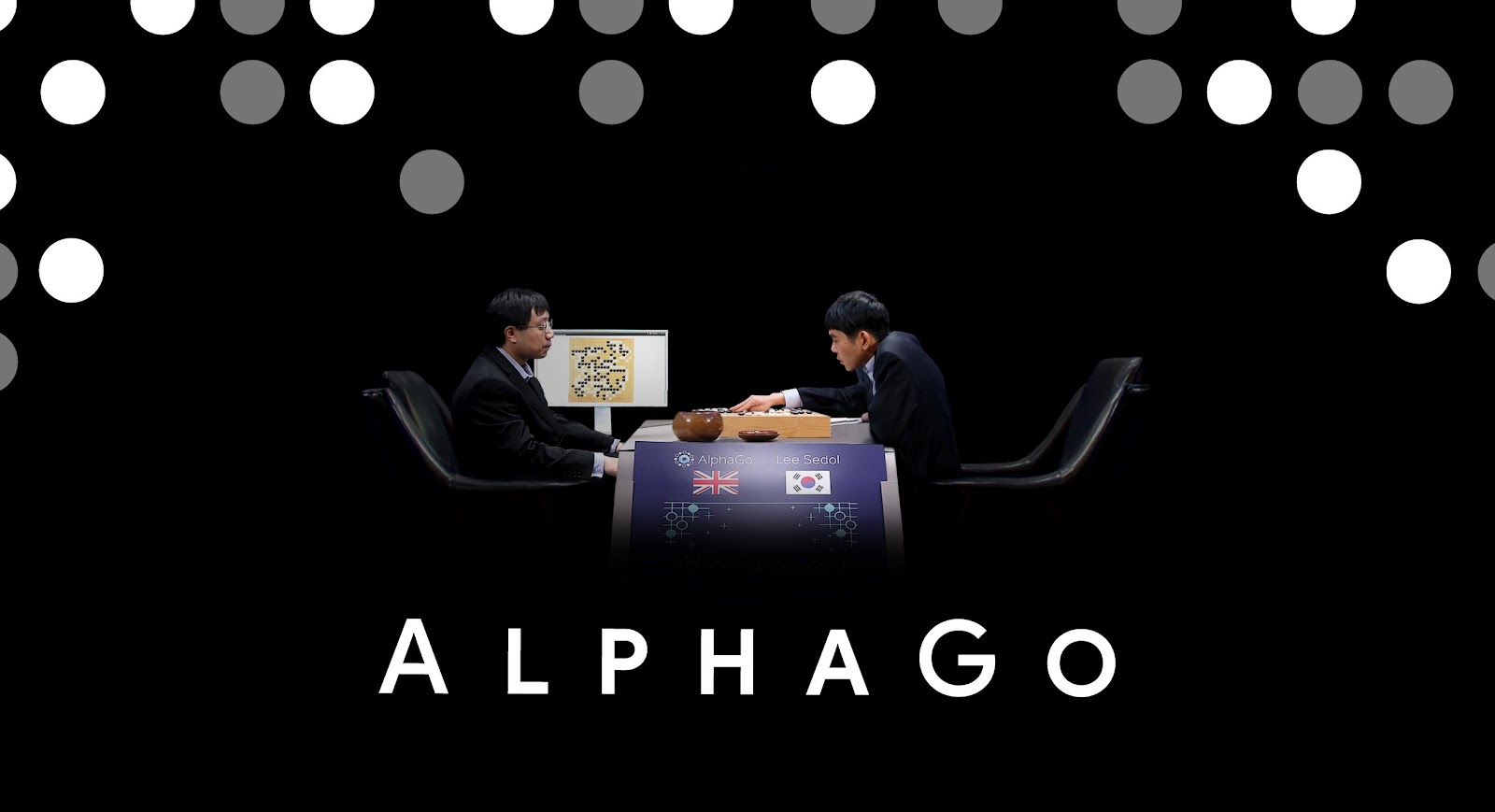
AlphaGo Movie (@alphagomovie) / X    AI began as a thing known as "deep learning" when a team called AlphaGo created a program that used thousands of recorded games of Go, learned the game, and taught itself to play and adapt. A notable cool mention is that his technology was created based off the human brain and its neural pathways. After some time, AlphaGo took on the world's greatest Go player, Lee Chang-Ho, and revolutionized the world in a single move, "move 37". Move 37, a move that was unfathomable by the human intellect, yet when it was produced by AlphaGo it was considered brilliant. This matchup consisted of five games, AlphaGo took four and Lee took one. 

    As remarkable as it is, AI spells danger for essentially everyone except the 1%. Every industry is looking at ways to utilize this disruptive technology and use everything new available to try and become more efficient. "In The Age of AI," the produce an inequality graph which showed that in the 1980's the working class (a blue line) started up high on the graph compared to the upper class (a red line). As time marched on the blue line crossed with the red line around late 90s-00s and has only continued to separate. AI will only exacerbate this and be very harmful for society, as the rich will get richer, and the middle class and poor will struggle harder. It is essentially the ultimate tool of wealth creation, as it is able to track user presences and conduct ad targeting. Companies like Google and Amazon utilize these because they are simply the best and this will allow them to make more money. 

    The video discusses shortly of the evolution of nature during industrial capitalism, turning land into real estate, creating labor and jobs which allowed the country to flourish. The parallel being the potential change to surveillance capitalism which would eliminate private human experience as businesses want to know what we will do now, soon, and later. The only difference being the latter having bad implications for the future of society. For example, a man shares his story of a dinner with his friend who works with Google; long story short he asks what's all this fuss about Google data tracking, expecting a "don't worry about it it's nothing." To which his friend replies "you'd be horrified how much we knew about you." It really makes you wonder how much Google and these other companies know about you, especially down to the minute details. 

    It is later stated that Googles business is learning everything about you that they can, what you like, who your friends are, your private thoughts, all for the purpose of turning the maximum profit. This is shown in-between 2000 and 2004, when Google's revenue line increased by 3,590% after they figured out they could see everyone's data allowing them to exploit it. Even scarier, little things, such as typing a paragraph versus typing bullet points in a message to a friend, are huge in predictive value, for example, companies can force you to see that is similar to something you have already bought or something you've expressly liked, so you are more likely to buy it.
    
    While it is very terrifying, there are definitely some positives to this new technology. I have exploited some of it myself, for example I have used ChatGPT to help guide some of my work and it allowed me to provide a better outcome. There will definitely be a lot of advancements in technology and medicine with AI, but the importance is to utilize it the right way and not allow companies that only see $$$ to get their grime filled hands on it. It is important to keep the middle class and the poor class protected, and not allow the rich to simply get richer at the expense of the prior.

Wednesday, February 7, 2024

Antiwar Blog

 Why Stop War When it Brings Home The $$$

The 60s Antiwar Movement in the US and How it can Inspire us Today


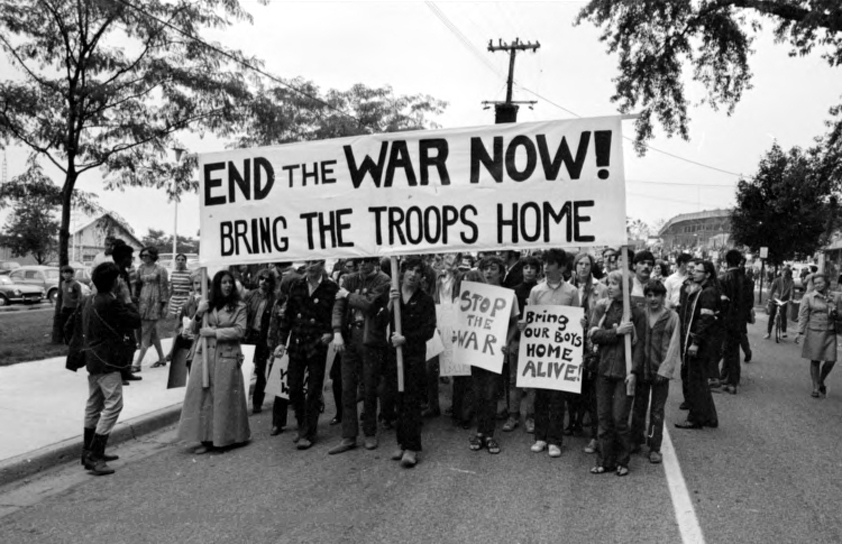
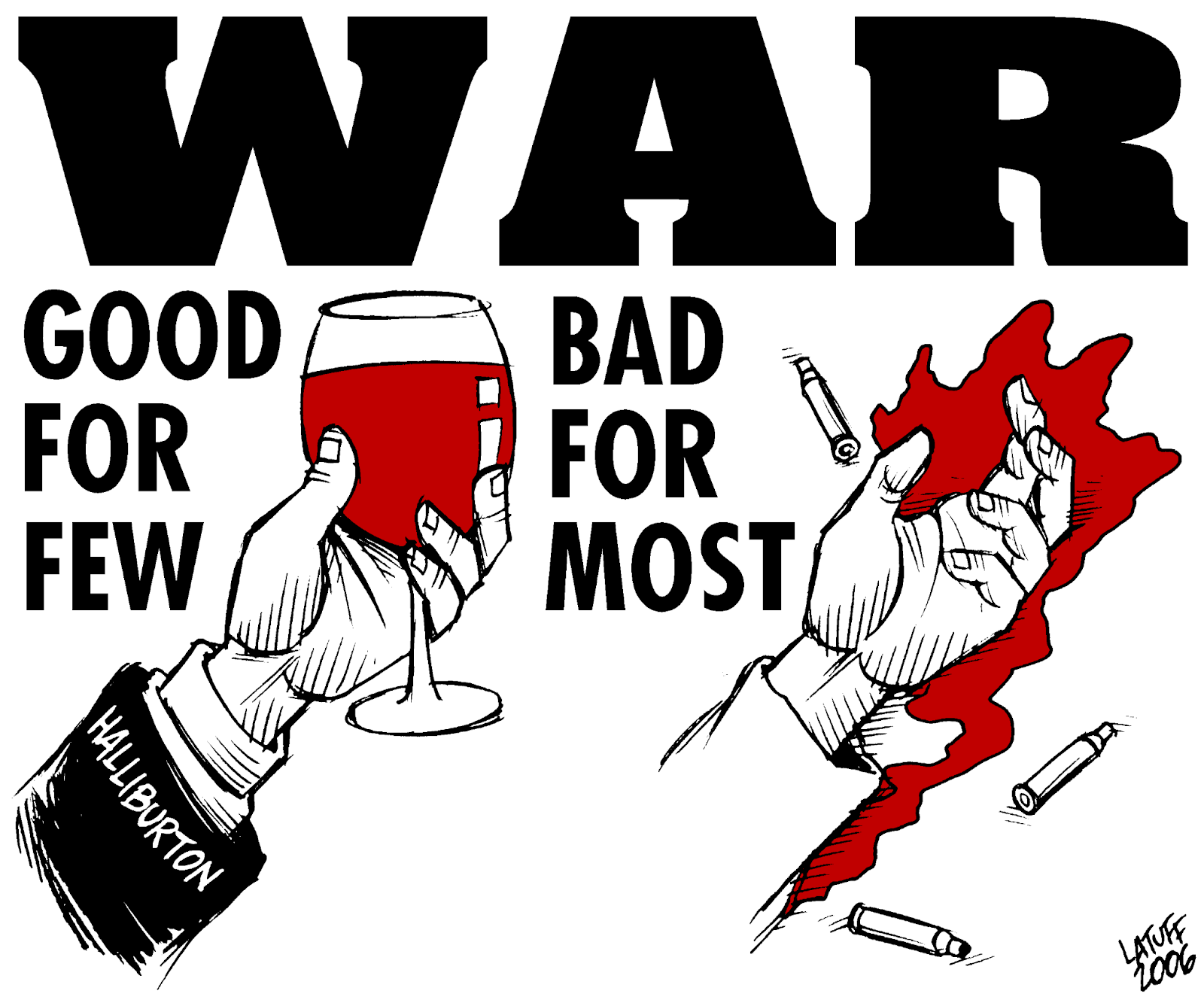
    It seems like a no brainer when you think countries and nations should not go to war, so why is it that people who are "antiwar" are rarely heard in the media, even today. The two sites, "antiwar.com" and "The American Conservative", are sites I can definitely say I have never heard of, or hear about in news or media. Yet these sites are packed full with protests against the war, supported with lots of articles and videos as evidence for their position. The reason news media does not cover these types of opinions and there is a necessary search for views such as these is because war allows for the government to make money and infringe upon our rights and civil liberties. 

Governments like to hide behind the term "necessary evil" when justifying wars and/or proposing to go to war. While to some it may seem for the betterment of the country or even make the world a better place, to others it is a waste of human lives, money, and resources. Like CCR said, "I ain't no fortunate born", the ones who profit most from war are the elite and the government. Like System of the Down said, "why do they always send the poor?", in reference to the people who actually have to go out and sacrifice in times of war. Song could be considered the best way to put an opinion out there against the war, so long as it is catchy, because it is the one way to get that viewpoint out to the masses without, in a sense, being censored.

As long as the government and elite can profit off the war, the voices against will continue to be suppressed and not put at the forefront of news and media. While the government and its officials may pretend to be against the war and hurt by the number of casualties arising, I'm sure there are some who actually are, as long as they are sitting pretty not having to go to war and turning some profit, they honestly do not give a rats ass and war is that necessary evil they love so much. 


Tuesday, February 6, 2024

Learning From the Class

    The Homing Pigeon 

  Carrier Pigeons. Someday they will be extinct. | by David Aron Levine | I.  M. H. O. | Medium

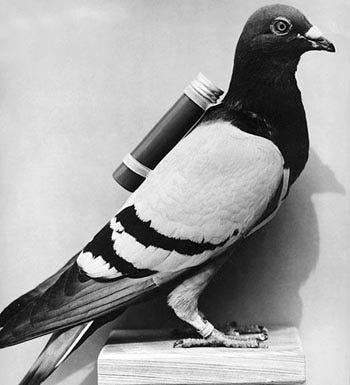
    There were a lot of great presentations on Thursday, the first of February, and everyone seemed well prepared if at least not slightly. The one that I felt peaked my interest the most, and probably others as well, was the history of the homing pigeon. The presentation was filled with both logos and pathos and was really well done, with no note cards, straight from the memory, it was very impressive.

What I learned

    First I learned about the timeline of carrier pigeons, when they were used and how they were used. Recording as being used as early as 3000 BCE in Ancient Egypt to send messages. As they evolved the next notable spot on the timeline was in 1167 when they were used to send messages along the Baghdad/Syria Route. In 1860 they are used by Paul Reuters as a way to bring messages between Brussels and Aachen, faster than the railroad. In 1897 they are used for the Great Barrier Pigeon-gram Service. I also learned about some pigeons and their use in major events such as both World Wars. Also their use in Indias Police forces and some even being used today to smuggle things into prison. There was also the story of Cher Ami, who was one of many pigeons deployed in WWI, who was able to save men who were being fired upon by their own brothers unknowingly. Cher Ami was able to take a hit, and with his carrier leg dangling, delivered the news to cease fire and that they were firing upon their own men. He saved the lives of many men and was rightfully honored. 

   It was fascinating to learn about this mode of media and how important they were, especially back then. It's ashame to see the way they have fallen from grace, now only serving the government for espionage.

The Invention of the Newspaper


The Newspaper

                                List of the oldest newspapers - Wikipedia  

  I would say it is safe to argue that a lot of the world, and most definitely anyone reading this, has picked up a newspaper at some point in their life. Whether it be to read what is going on in the world, to look for job postings, or just simply stop and see the comic strips; but at some point that newspaper was in your hand, even in todays world of technology and medias. Newspaper could be considered one of the greatest medias of all time, due to the impact and longevity of it. Johannes Gutenberg was the father of print, when he invented his printing press in 1440 he established himself as a very important and influential pioneer when essentially creating the world first newspaper. The printing press was comprised of small metal pieces with raised backwards letters, known as movable type, arranged in a frame, coated with ink, and applied to a piece of paper. He created it in Mainz Germany, in roughly 1440 and it took flight in 1450 after the printing of the Bible. From the on print work would continue to grow and evolve into what we know today.


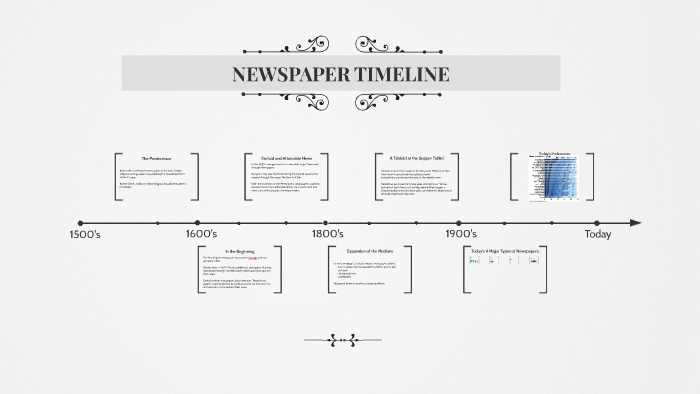
NEWSPAPER TIMELINE by Andrea Bales on Prezi NextHISTORY OF THE NEWSPAPER

  • 1605 - The modern newspaper is born in the autumn on the position of the Holy Roman Empire (Strassburg)
  • 1609 - The first weekly newspaper to employ Gutenberg's Printing Press emerges in Germany, and begins to change the way news is being read
  • 1621 - For the first time a country other than Germany prints when England prints its first newspaper: "Corante or weekely newes from Italy, Germany, Hungary, Poland, Bohemia, France and the Low Countreys."
  • 1641 - By this point in time, a newspaper was printed in almost every country in Europe as publication began to spread towards France, Italy, and Spain. Newspaper followed two formats at this point, the Dutch and the German. The Dutch consisted of a densely packed 2-4 page paper and the German consisted of an expansive 8-24 page paper. Newspapers began printing with the Dutch format, but as they grew, they switched to the German
  • 1690 - Newspaper hits the American colonies on September 25th for the first time when Benjamin Harris printed "Public Occurrences: Both Forreign and Domestick." 
  • 1791 - The nascent United States of America adopts the First Amendment into the Bill of Rights, essentially giving the people the power to print whatever they would like into the papers.
  • 1798 - In response to the free use of words and right to press in the First Amendment that the American citizens have exploited, the government establishes The Sedition Act. The Sedition Act states that any writing, printing, uttering, or publishing of anything false, scandalous, or malicious against the United States government was punishable by fine and imprisonment. 
  • 1833 - Newspapers are revolutionized with The Penny Press. In 1883, Benjamin Day creates The Sun, a newspaper in which he prints on small, letter sized pages, and sold them for only a penny.
  • Late 1800's - Yellow Journalism is born, thanks to Joseph Pulitzer. Yellow journalism is a style of journalism that focuses the stories on things such as violence, crime, sex, and emotion. However these reports came to be known as inaccurate, misleading, and exaggerated in detail.


Impact of the Newspaper
   
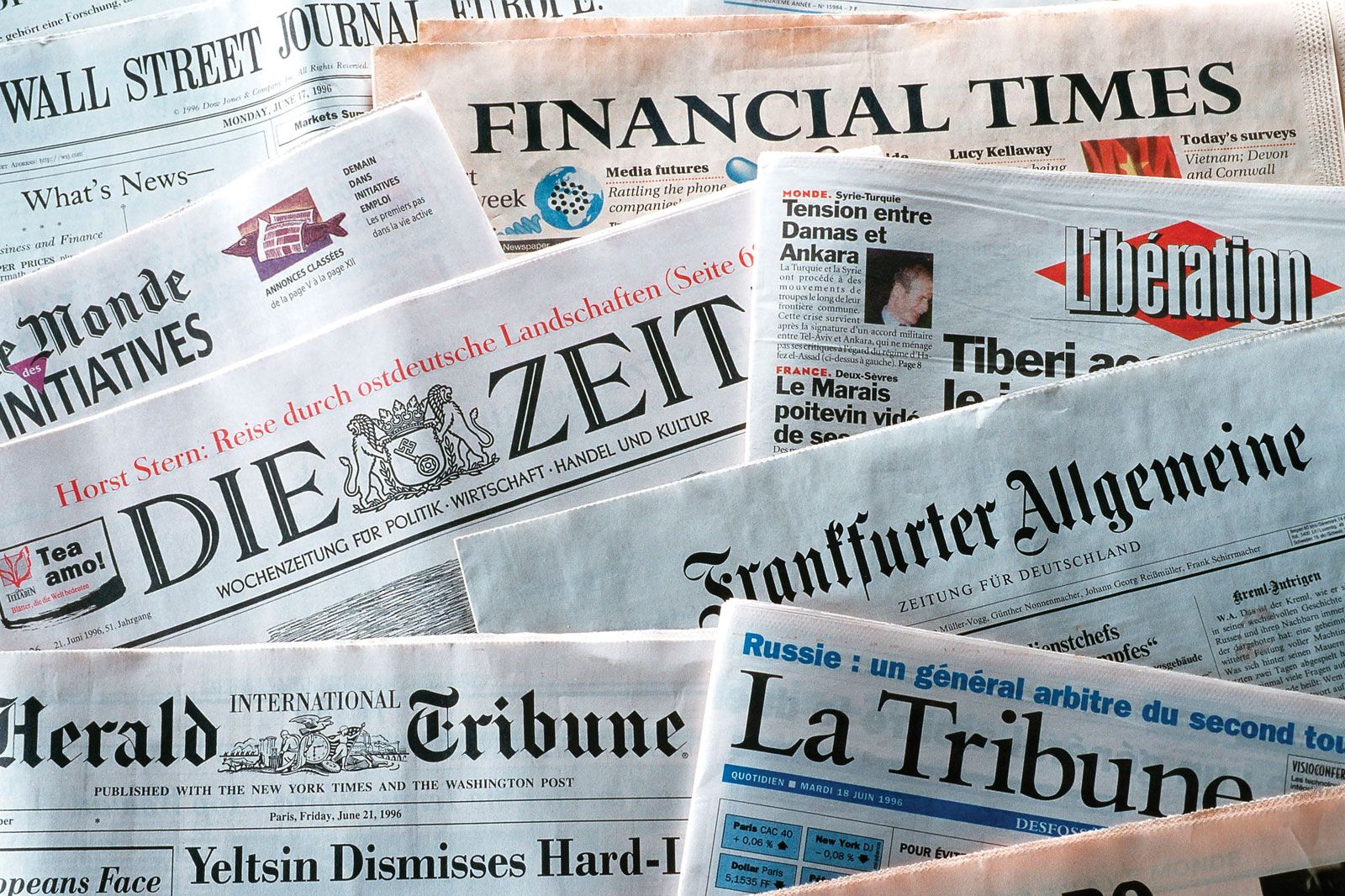
Newspaper | History & Facts | BritannicaThe impact the newspaper had on the world can simply not be understated, as it revolutionized media and acted as a template for technology we still use to this day. When newspapers were first released upon the masses only the elite and upper class were able to read them because of how expensive they were, factors such as the amount of time it took to produce a single paper and the price to make them. Even until the early 1800s newspapers were still really only available to the elite being priced at six cents per copy, a price artisans and working class citizens could not afford. That is until the Penny Press revolutionized newspapers and essentially created mass media. The papers that were available for purchase for a penny as they were creating roughly 18,000 more copies per hour than the traditional press. This allowed anyone to be able to read the newspaper, connecting the world through news. It also ended up the creation of the freedom of press, which is still an ideal this country holds to this day, sorta...

    However, the newspaper is one of the most influential pieces of technology this world has ever seen. Without the creation of the printing press and then eventually the newspaper, the world would have needed to found a completely different way to get not only individual news, but world news in general. The technologies we have today and our fathers had before us are all due to the pioneering of the newspaper.


Wednesday, January 24, 2024

The Eight Values of Free Expression

The Eight Values of Free Expression

The Power of Free Expression in America: Harris, Frank, Dunklee, Jerry:  9781516545094: Amazon.com: Books


The Statue Of Liberty Represent Freedom, Democracy (and Much More!)

How important is the idea of freedom and liberty that this great country was founded upon to you? To me it is pretty damn important, as it is the most known and appreciated factor which makes America the nation it is today. The eight values of free expression, without going into detail are; Marketplace of Ideas, Participation of Self-Government, Stable Change, Individual Self-Fulfillment,  Check on Government Power, Promote Tolerance, Promote Innovation, and Protect Dissent. These are the philosophies and ideas of the incredible men who instilled these eight values into our country.


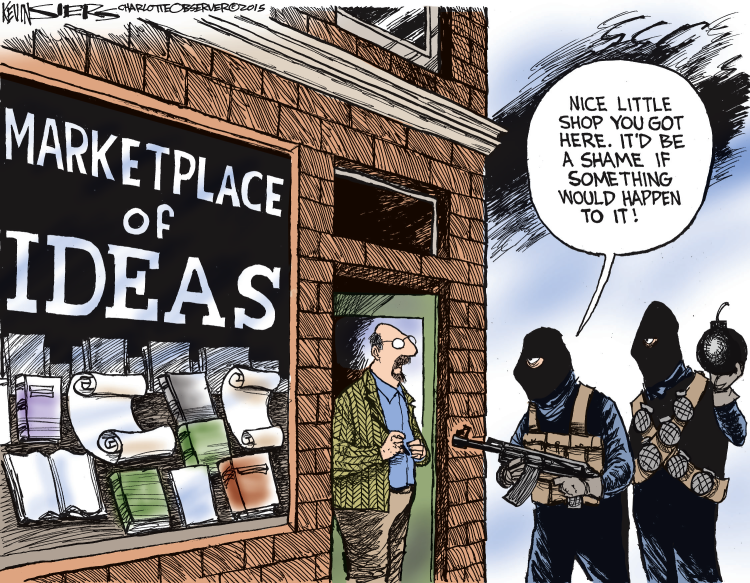
Three critiques of the marketplace of ideas | prior probabilityOf those values, the one that resonated the most with me was that of John Milton, the Marketplace of Ideas value. This is when truth and falsehood are allowed to freely grapple, the truth will win out. And the grappling makes the truth even stronger. The idea behind the Marketplace of Ideas is that people should be allowed to say things that are false, because when those ideas go against those of the truth, the truth will end out on top. This resonated with me the most because it feels like a very strong representation of what democracy is about in our country. The idea that people can debate and argue their ideas and even though one is wrong, whether the person is aware of that or not, the truth will reign supreme is truly fascinating and makes sense. I feel that Milton was also trying to get at the fact that people will also come to understand the truth and the reason that it is so.


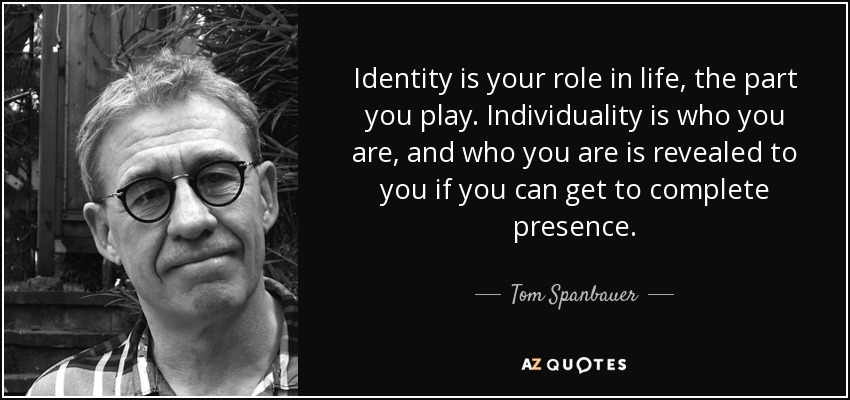
However, the value that I think is most important to our country is that of Individual Self-Fulfillment: Free speech enables individuals to express themselves and thereby create their own identity - and in the process perhaps, find kindred spirits. Individuality is perhaps the most important thing a society needs to understand and accept if it are to be ideal and functioning. Individuality is also a strong identity that separates us from the government, and allows the government to be controlled by those who are governed as stated in Professor Dean Smith's prerequisite for democracy. While people will be individuals, as stated in the value, it could also potentially bring out kindred spirits, which means those who share the same attitudes and characteristics. While it could, but does not necessarily, it does not take away from the individuality of the peoples. 

Tom Spanbauer quote: Identity is your role in life, the part you play...


When the Censor Comes - Freedom to ReadThe two values that I believe associate most with what is going on in our world today is the Check on Governmental Power  the freedom of the press enables citizens to learn about abuses of power — and then do something about the abuse at the ballot box if they feel so moved; the other is Promote Tolerance  It has been argued that freedom of speech, especially through our practice of extending protection to speech that we find hateful or personally upsetting, teaches us to become more tolerant in other aspects of life — and that a more tolerant society is a better society. We, along with the press, are part of the check-and-balance system to restrains government power and the abuse of it. There is a lot of censorship going on in the current United States of America, for example, "Murthy v. Missouri"(formerly "Biden v. Missouri") is a court case where Missouri, Louisiana, and many other private plaintiffs alleged that the first amendment was violated by federal officials who were coercing social media companies get rid of or dismiss their platforms content. This is a clear example of censorship that the people who the government are instated for should be made aware of. This is a perfect example of abuse of power, so the people must be aware so they can do something about it if they see fit. Therefore, we will not end up in a society where the government controls what the people say and see. Another big vehicle for censorship is cancel culture, which in my opinion is stupid in most cases. This culture will claim offense for others', who honestly may not even be offended, and cancel someone who said or did something in the past when times were different. I'm not saying that makes it ok, however, if those people were to understand the promotion of tolerance, they would understand that society as a whole begins to understand these things and that's how we evolve.

It is truly amazing how these values, although created and thought about a long time ago, still hold value to this very day and should very much continue to be studied and materialized.


Tuesday, January 16, 2024

The Supreme Court


United States Supreme Court


The U.S. Supreme Court has been around for over 200 years, and with that, there are years of knowledge, history, and inevitable change. The video on the Supreme Court reiterated information that I already knew like basic information of the Supreme Court - i.e. 9 justices serve - and a lot of things that I had never known or heard before. Something that I feel is a common theme for me is that there are a lot of things I need to read up on more and delve into.


I learned many things about the Supreme Court through the video, such as the fact that the Supreme Court remains the most powerful body in the world. There have been a total of just over 100 justices who have served on the court, serving an average of 16 years. I also learned that the citizens of the US have not always accepted the power of the Supreme Court, before a man named John Marshall that is, who helped establish a principle known as "judicial review" in the famous case "Marbury V. Madison"

                                                                                                                  John Marshall


I also learned that the Supreme Court receives over 7000 cases a year, they accept roughly 100 a year and a justice reviews them once a week; along with the fact that the justices are independent and do their own work. The most surprising thing I learned, also my biggest takeaway, is the confirmation process. It is a very important process in which the nominee is confirmed into the Court and essentially separates themselves from civil opinion and influence and makes them their own entity. Another strength they have is that they can check the actions of both other branches of the U.S. government.


The video drastically changed the way I think about the Supreme Court, honestly, it taught me a lot about it. Especially the fact that the Supreme Court is not an entity of 9 justices who think the same and work together. It is a composition of entities that each have their own opinion and work together to decide what is, or isn't, constitutional. It also changed the way I think about the justices, the same idea of being their own person and deciding everything based upon their own opinion and that of their colleagues

Thursday, January 11, 2024

Top 5 News Sources


1. Instagram - https://www.instagram.com

I get a lot of information about things happening in the world from Instagram. Information ranging from what's going on in the sports world with my favorite teams and players to a little bit of politics and current events that are happening.


2. My Mother (Not my actual Mother pictured)

I do not really watch a lot of news, or really any, at least not on the television. However, my mother does and she likes to talk to me about what is going on in the world; so if I do see some news on the TV it is because she has it on in the living room and I may listen in for a little. She will also reiterate to me a bit of what she's watched and give me her own opinion to follow, back it up, or dispute it. She watches a lot of Fox.


3. My friends

Like myself, at least to my knowledge, most of my friends do not pay too much attention to the TV or social media news, but some of them do. They will bring up discussions amongst our peers about what is going on, to which I sit and listen because I do not really feel confident giving information due to the fact I feel I don't know what I'm talking about. 


4. The internet - www.google.com

Since I do not really watch a lot of news or pay attention to a lot of politics, sometimes I will hear about something from my friends or maybe see a little preview of something on social media and will turn to the internet to find out more information if it intrigues me. It is definitely the source with the most information, but there is also so much information and bias on the internet so it's hard to determine what to believe/agree with


5. The radio

Every now and then when I am driving with my Mom she will have the radio on and it could be talking about anything Philly sports or good ol' fashioned politics. I mostly only listen to the sports stuff because I hate politics; in fact, I stopped pursuing being a lobbyist because I loathe the thought of working for politicians. However, every now and then something will perk my ears and I will listen thoughtfully and intently.


Relationship with technology

 Technology: The Good, The Bad, The Ugly I have been exposed to technology since the day I gained consciousness, and in turn I feel I have h...